Chumbak (GOAT Brand Labs)

AI catalog of 3,000 SKUs: how 24.online helped Chumbak significantly accelerate visual content updates without losing brand consistency

Indian D2C lifestyle brand Chumbak (GOAT Brand Labs portfolio) refreshes listing visuals to a strict 8-artboard template. An AI pipeline with self-service replaced a chain of six contractors per SKU.

Impact Significant cycle acceleration (days → one day); image cost substantially below studio rates
Industry
D2C Fashion & Lifestyle
Duration
Audit 2 wks · development & integration 2 wks
24TTL team
Project Manager, Senior Consultant, Lead Computer Vision Engineer, ML Engineer (image generation), Senior Designer, Backend Developer
All cases →
Significant cycle acceleration (days → one day)
Image cost substantially below studio rates
3,000 SKUs, up to 18,000 images per year
Vast majority of listings pass brand compliance checks

Context

Chumbak manages a catalog of ~3,000 active SKUs across 100+ categories — from totes and wallets to ceramics and copper bottles. Channels: chumbak.com + global.chumbak.com, Flipkart / Myntra / Amazon.in / Snapdeal, and 50+ retail stores. Every collection requires a scalable package: packshot, lifestyle, infographics, motif details.

Following the GOAT Brand Labs portfolio acquisition, the brand operates under operational pressure — levers are sought through unit economics and speed. The listing production cycle turned out to be one of the costliest and slowest nodes.

Challenge

A full package for a single SKU (5–6 images in an 8-artboard composition) took 5–7 days and cost $30–80 per image. For a catalog of 3,000 SKUs with 30–40% annual refresh — 15,000–18,000 images and a budget of $0.4–1.4 million per year for production alone.

Production was distributed across multiple agencies and orchestrated by a single content manager; up to six contact persons were involved per SKU. Off-the-shelf generative models "drifted" on dense ornamental prints and distorted the geometry of ceramics and wood, destroying brand recognizability.

Project goals

What the AI did

An AI pipeline refreshes D2C listing visuals: packshot → lifestyle → infographic, following a strict template with brand compliance checks and self-service access for agencies.

01

Pilot of 200 SKUs in 30 days — a unit economics breakthrough

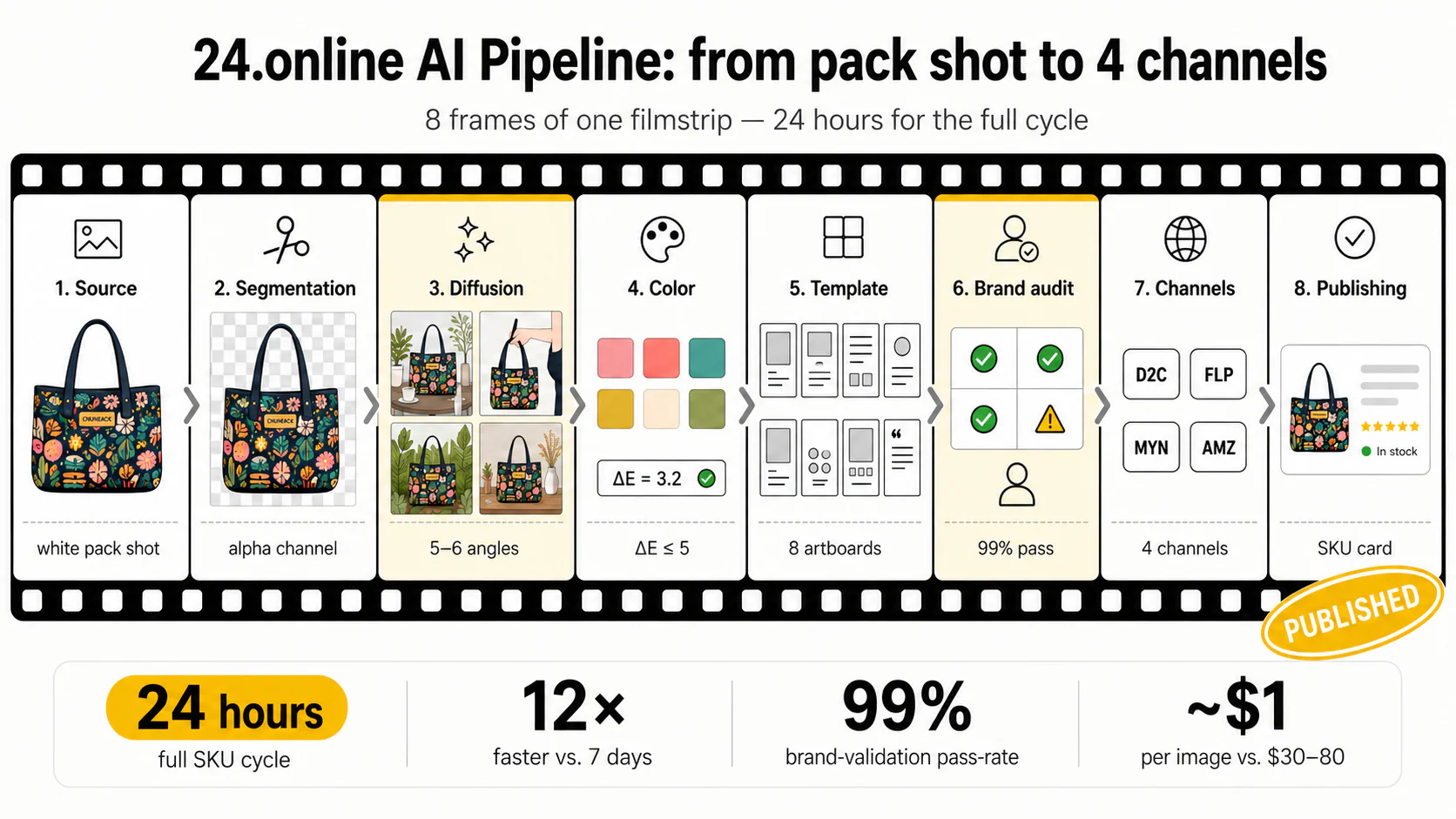
An image-to-image pipeline on a fine-tuned diffusion model trained on Chumbak's brand visual corpus was deployed for the priority pool. The content manager uploads a reference packshot → the system generates 5–6 angles across four templates. $1,000/month for the pilot vs. $8,000–16,000 in photo production — a significant cost reduction, cycle from 7 days to 24 hours.
02

Visual consistency across the overwhelming majority of listings

The color-preservation pipeline verifies each image against the reference palette for the SKU from the PIM (ΔE ≤ 5 in CIELAB), checks for brand motifs, and verifies texture correctness. If the image fails, it is returned to the queue with a refined prompt — no manual rework; the brand auditor sees a deviation heatmap.

03

Self-service for 5+ agencies

An interface with a role model (brand manager, brand auditor, agencies — each with their own access scope), API rate limits, and an audit log. Multiple agencies work in parallel: significant throughput increase, the single-point-of-failure on one manager is eliminated, SLA for returning a package goes from 3 days to 4 hours.

04

Scaling to 3,000 SKUs

The model is fine-tuned on an expanded corpus — all 100+ categories with emphasis on new texture classes (painted ceramics, wooden tableware, copper bottles, embroidered textiles). The self-service infrastructure scales without linear headcount growth on the vendor side.

Generative Listing Visuals — Processing pipeline
Processing pipeline

Before and after

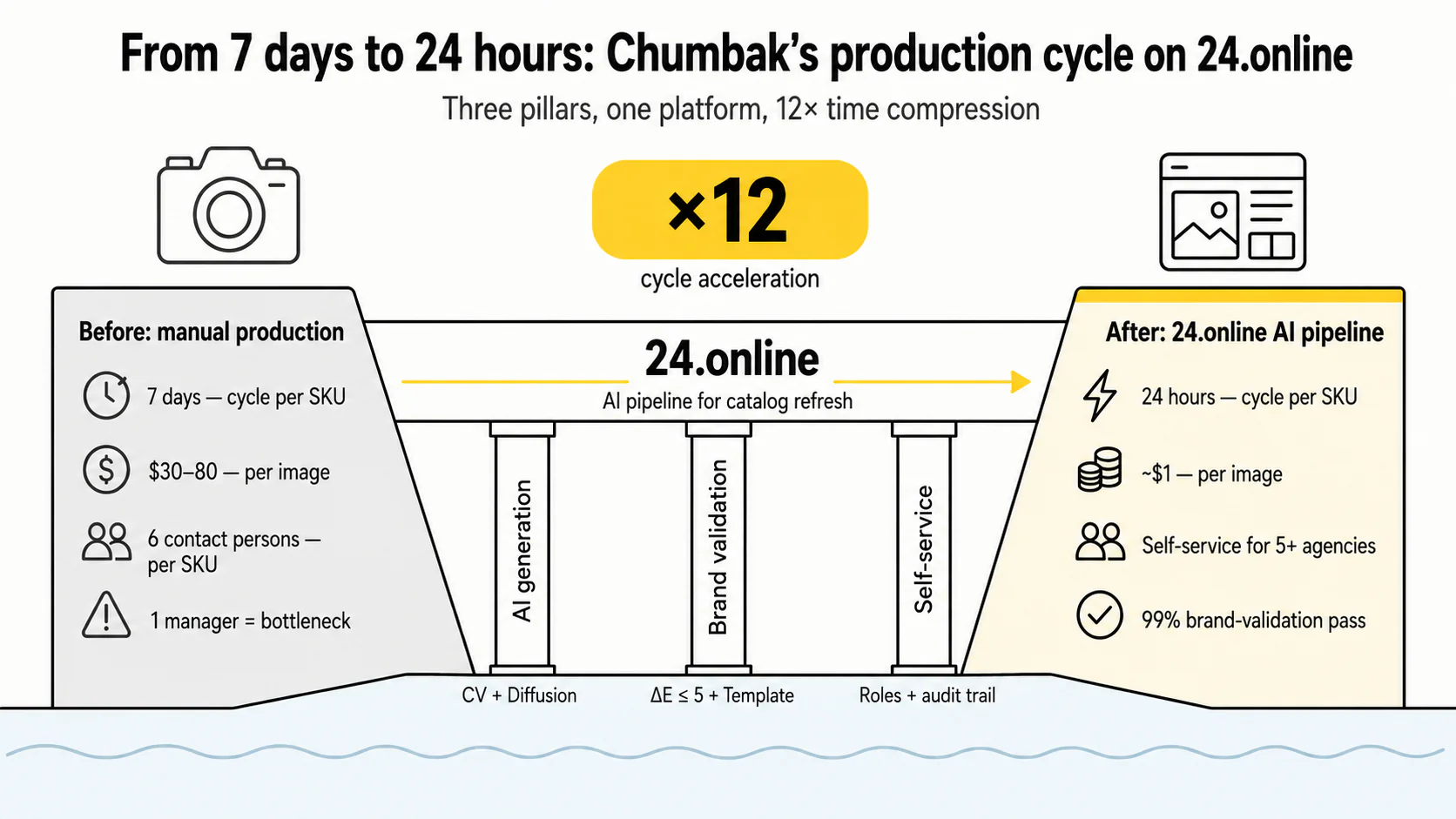
Before — manual
  • ×Prepared a packshot brief and aligned it with the agency for each SKU
  • ×Organized a separate photo session for each SKU
  • ×Retouched and color-corrected manually in Photoshop
  • ×Manually composed 8 artboards into an Adobe Illustrator template
  • ×Checked color against the physical sample for each image
  • ×Coordinated all agencies through a single content manager
  • ×Managed visual approvals over email and Slack, losing track of versions
Now — AI agent
  • Extracts the product from a packshot with a transparent alpha channel
  • Generates 5–6 angles across four templates in parallel
  • Places the product into an approved lifestyle scene for the collection
  • Applies color preservation with ΔE ≤ 5 against the reference palette
  • Assembles 8 artboards into the brand grid automatically
  • Returns non-compliant images to the queue with a refined prompt
  • Grants agencies self-service access and builds a deviation heatmap for review
Generative Listing Visuals — Before and after
Before and after

Results

Technical metrics
  • Brand-check pass rate: overwhelming majority of listings without manual correction
  • Color accuracy: high palette fidelity (target threshold ΔE ≤ 5 in CIELAB)
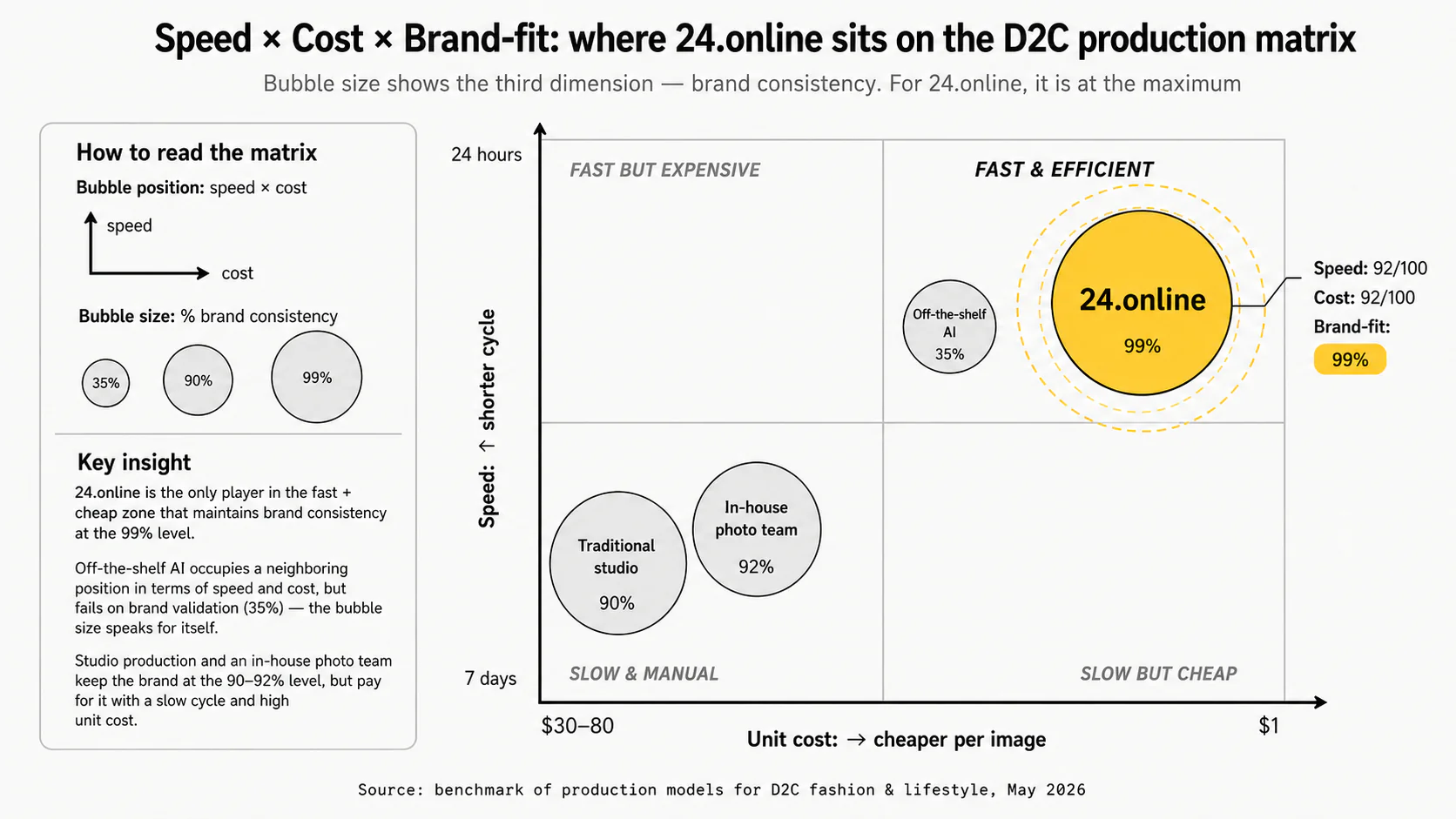
  • Production time: 24 hours for an 8-artboard package vs. 5–7 days
  • Target throughput: 15,000–18,000 images per year for 3,000 SKUs
Business metrics
  • Per-image cost: $30–80 → ~$1 (significant reduction)
  • Annual production budget: $0.4–1.4 million → ~$12,000 per year
  • Collection time-to-market: 5–7 weeks → 1 week
  • Cycle per SKU: 5–7 days → 24 hours (significant acceleration); 5+ agencies in parallel
Generative Listing Visuals — Speed and cost
Speed and cost
Strategic impact

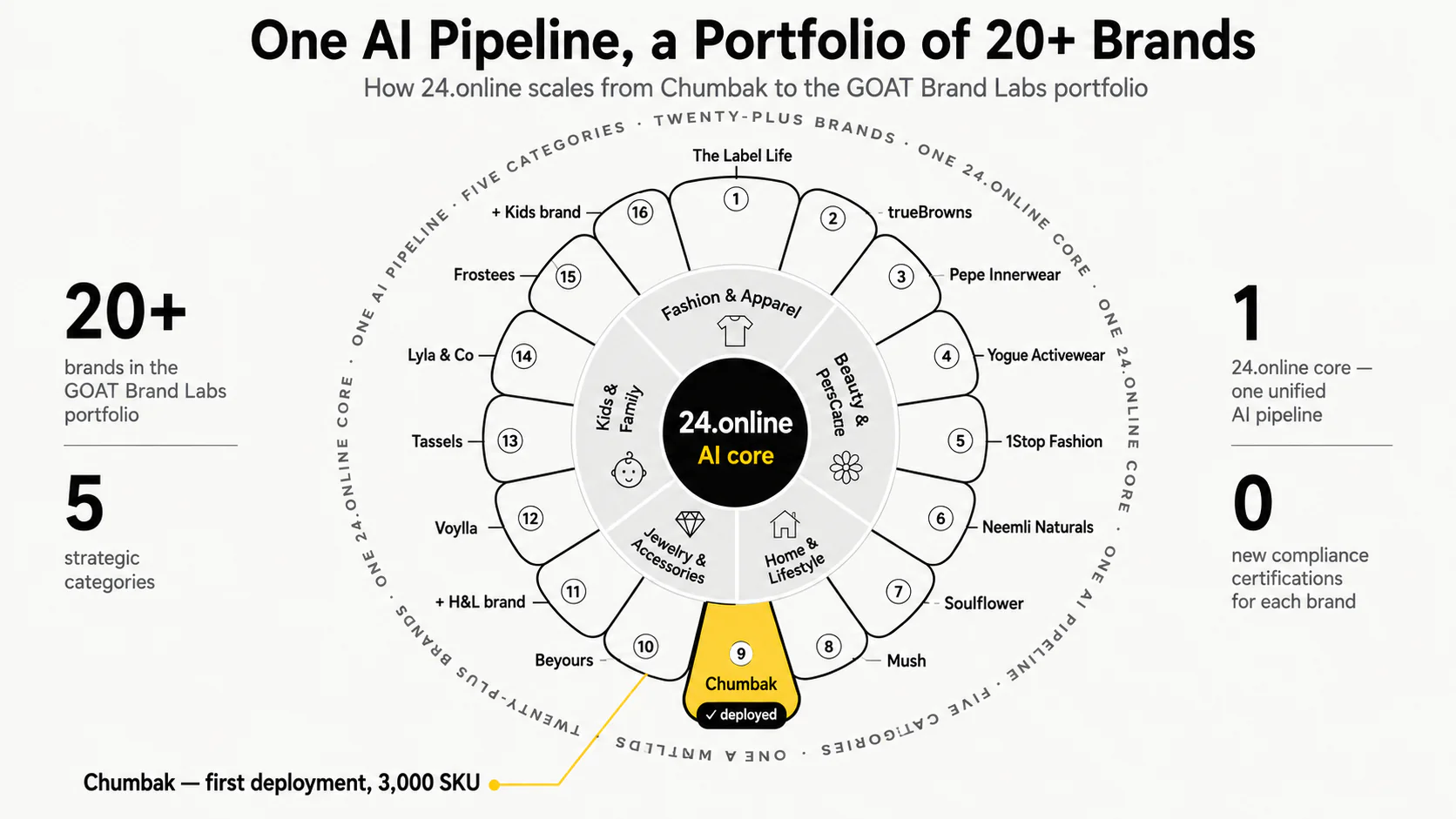
The self-service mode, proven with Chumbak, is ready to be rolled out across 20+ brands in the GOAT Brand Labs portfolio — each connects via its own template configuration on top of the shared 24.online core.

This changes the ROI calculation for GOAT: production economics scale without linear vendor headcount growth, and Chumbak brand management is freed up for strategic work on the international catalog.

Generative Listing Visuals — Portfolio scale
Portfolio scale

The metrics and results presented reflect outcomes of a specific project and depend on its initial conditions. They are provided for informational purposes only, do not constitute a public offer, and do not guarantee similar results in other projects. Supporting materials are available on request.

Other cases

Facing a similar challenge?

Tell us about your process — we will suggest an audit, pilot, or full deployment.