International FMCG Manufacturer

How generative AI helped design an SEO pipeline for 21 SKUs with the potential for significant visibility growth and compressed the listing launch cycle from weeks to hours

An international FMCG manufacturer consolidated its e-commerce content operations and replaced part of the agency production with an AI pipeline. The pilot covered a line of 21 SKUs across Ozon, Wildberries, Yandex Market, and pharmacy retail channels.

Impact Measurable improvement in listing SEO index and a significant acceleration of SKU launch
Industry
FMCG / OTC / Personal Care
Duration
Audit 2 wks · development & integration 4 wks · monthly retainer
24TTL team
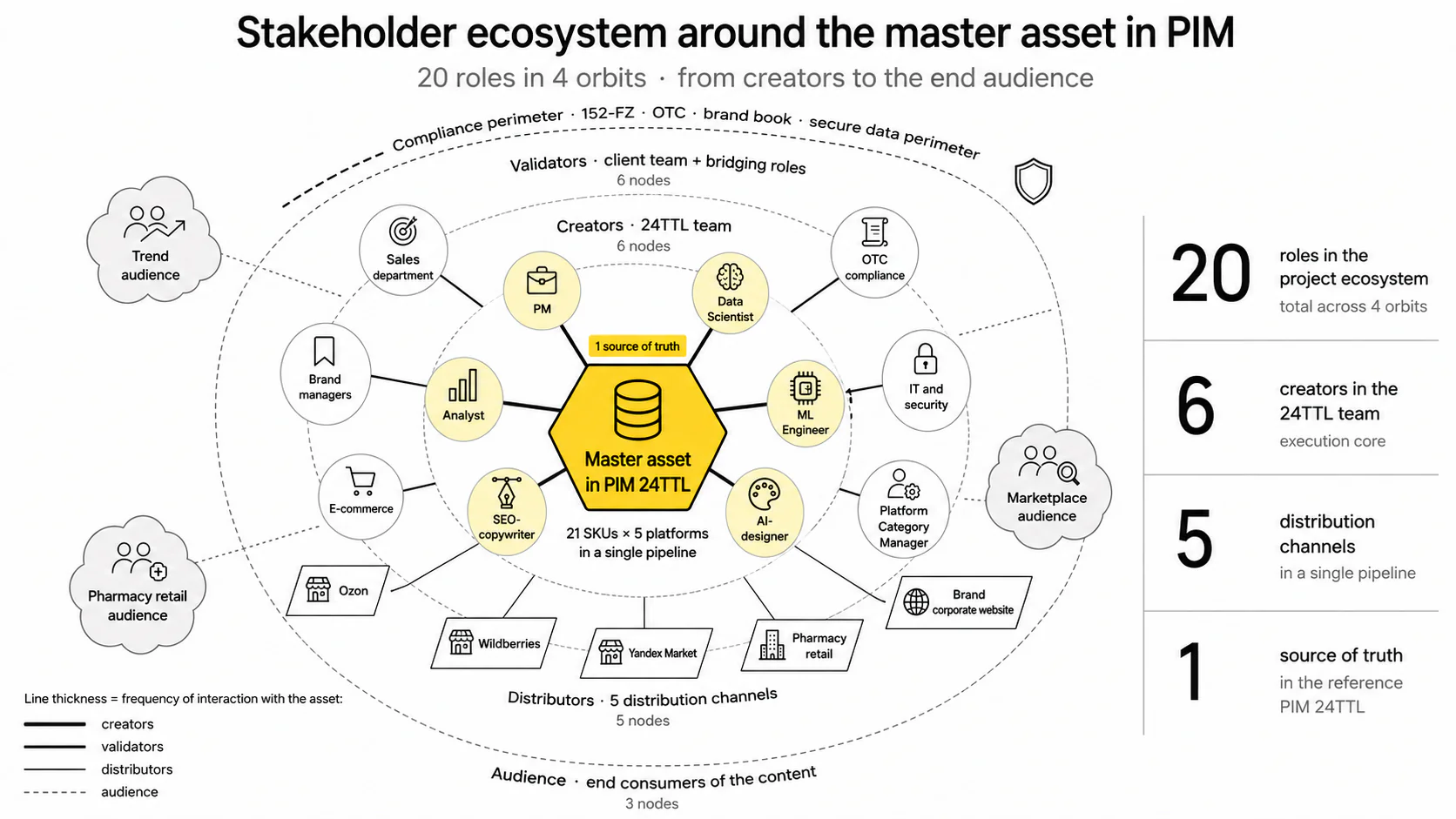
Project Manager, Senior Consultant, Data Scientist, ML Engineer, Designer, Copywriter, Backend Developer, Analyst
All cases →
Measurable improvement in listing SEO index during the pilot
Significant acceleration of SKU launch (weeks → hours)
21 brand SKUs in a unified AI pipeline
4,000–6,000 characters of SEO description generated from scratch

Context

In early 2026, the client was restructuring its e-commerce content operations: the sales team launched an "Ecom content 2026" RFP to consolidate marketplace and pharmacy retail listings under a single contract and replace part of the agency production (photo + design + SEO) with an AI pipeline.

The pilot brand was a line of 21 SKUs with a strong social foundation — a 4.9 rating and over 56,000 reviews — that was nonetheless using only a fraction of its SEO potential.

Challenge

The audit revealed that the flagship listing, despite a 4.9 rating and 1P seller status, achieved an SEO index of 72 out of 200 on the Ozon 2026 algorithm scale. The "Description" field had 0 characters (all text was hidden in a rich-content image and not indexed); the semantic core consisted of 27 hashtags with no brand keywords. Estimates pointed to a significant share of unrealized organic traffic in the category.

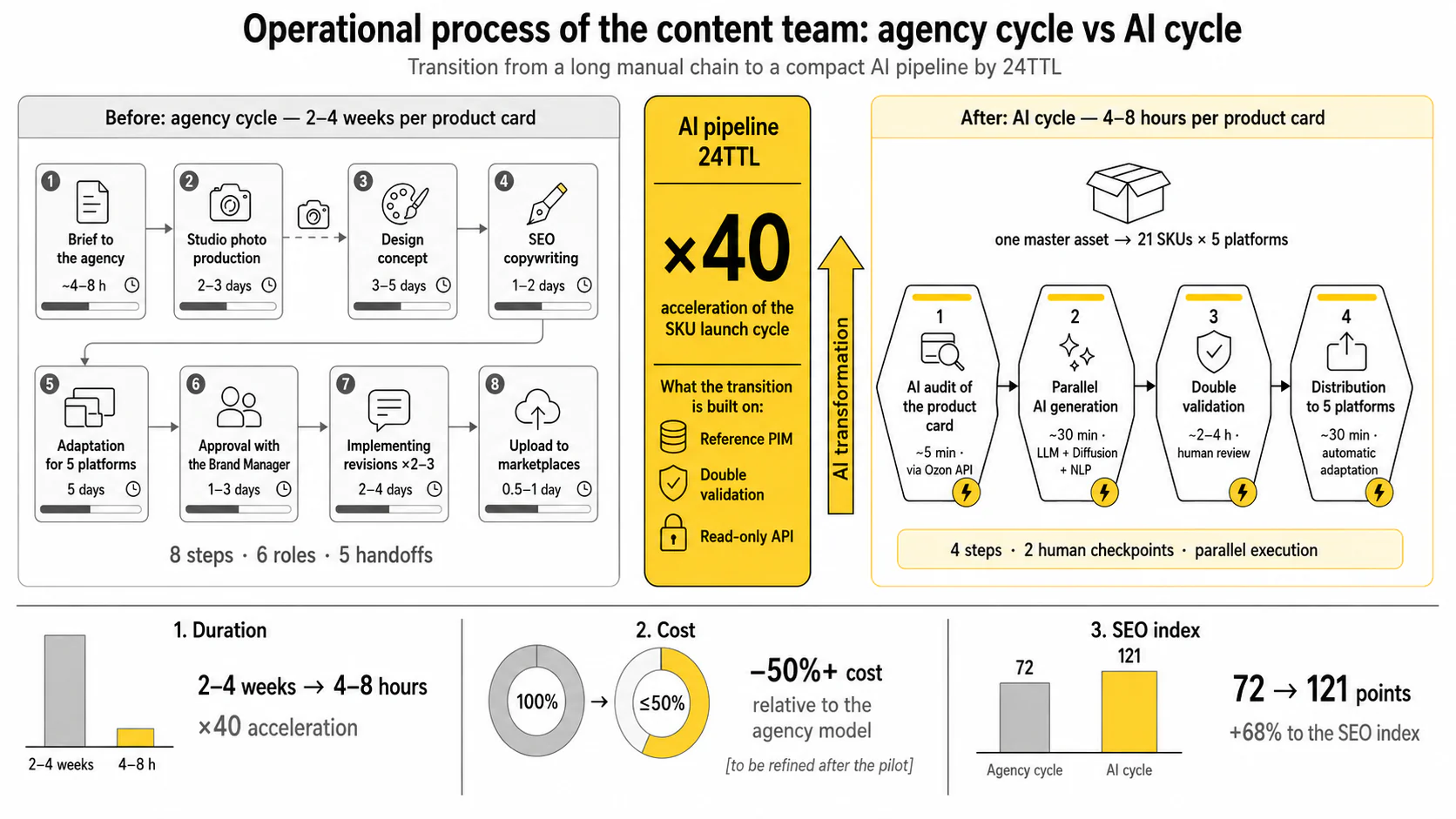
Launching content for a single SKU took 2–4 weeks: agency brief → photo production → design → 2–3 revision rounds → SEO → adaptation for each platform → brand book sign-off. Across 21 SKUs × 5 platforms, this yielded up to 105 unique creative cycles per year.

Project goals

What the AI did

Generative AI rebuilds SEO content and visuals for product listings: copy, hero images, and rich content tuned to marketplace algorithms — all in a single pipeline.

01

AI audit and SEO overhaul of 21 SKUs

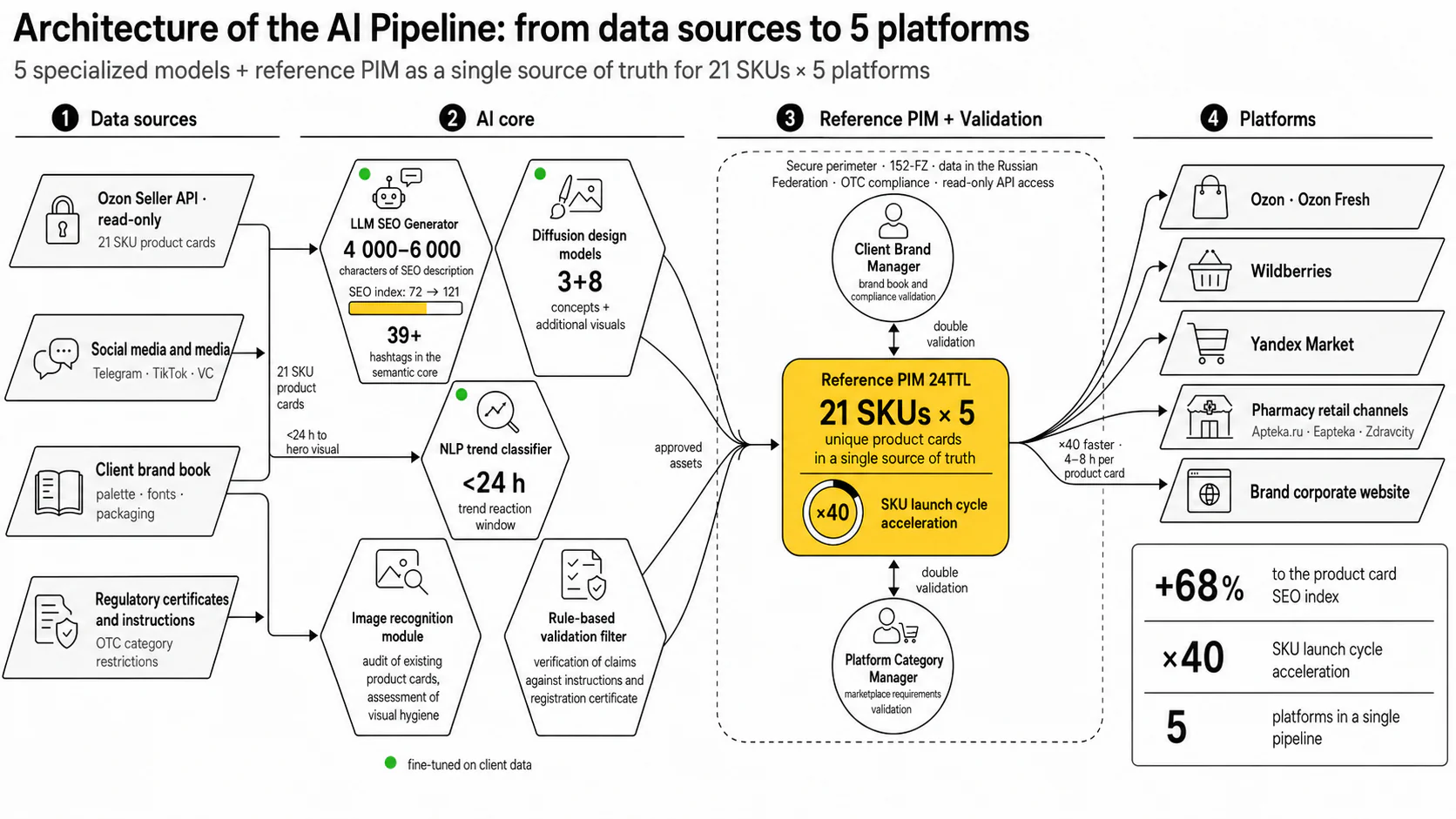
The AI auditor processes a listing in one hour via the Ozon Seller API (read-only) and scores SEO potential on a 100-point scale. The LLM generator builds an expanded semantic core (27 → 39 hashtags) and a description of 4,000–6,000 characters; the scoring model forecasts a significant index improvement (72 → 121 per model forecast).
02

Visual concept in one week

The generative module renders 3 hero concepts in the brand palette with required packaging elements and labeling; after brand validation — 8 additional images (lifestyle, infographics, macro). The "brief → 3 concepts → 8 images" cycle closes in 5 business days instead of 3–4 weeks of photo production.

03

Adapting the master listing to 21 SKUs and 5 platforms

One approved listing is automatically rolled out across all packaging sizes and platforms (Ozon → Wildberries → Yandex Market → pharmacy retail) with color correction and cropping for safe zones. The new SKU launch cycle is 4–8 hours instead of weeks.

04

Trend scanner with a 24-hour reaction window

An NLP classifier scans Telegram, TikTok, VC, and industry media, identifying stable cultural signals, whereupon the generative module renders hype images within <24 hours. The brand catches news hooks at peak audience attention rather than after it.

05

A+ rich content with mobile adaptation

The module generates 3 conceptual variants; after approval — a full set of up to 6 screens with automatic adaptation to the mobile version of the platform, extending blocks without re-rendering the base screens.

AI SEO Optimization for Product Listings — Solution architecture
Solution architecture

Before and after

Before — manual
  • ×Agency brief for each new listing and each SKU separately
  • ×Studio photo production for each packaging size
  • ×Manual semantic collection via third-party SEO tools
  • ×Hero and rich-content design in Photoshop, 2–3 revision rounds
  • ×Design adaptation to each new platform from scratch
  • ×Manual trend monitoring, reaction launched weeks later
  • ×New SKU launch = new cycle from scratch
Now — AI agent
  • Parses the listing via the Ozon Seller API and runs an automated audit
  • Scores SEO potential on a 100-point scale relative to the category
  • Generates a semantic core for the Ozon 2026 algorithms (39+ hashtags)
  • Writes an SEO description of 4,000–6,000 characters aligned with the brand book
  • Renders 3 hero concepts and a set of lifestyle images
  • Adapts the master listing to 21 SKUs and 5 platforms in hours
  • Catches micro-trends and creates images for them in <24 hours
  • Maintains a single reference repository and monitors the listing 24/7
AI SEO Optimization for Product Listings — Process: before and after
Process: before and after

Results

Technical metrics
  • Flagship listing SEO index: 72 → 121 (significant improvement per scoring model forecast)
  • Semantic core: 27 → 39 hashtags (substantial expansion)
  • Listing text description: 0 → 4,000–6,000 characters
  • 21 SKUs × 5 platforms in a single source of truth
Business metrics
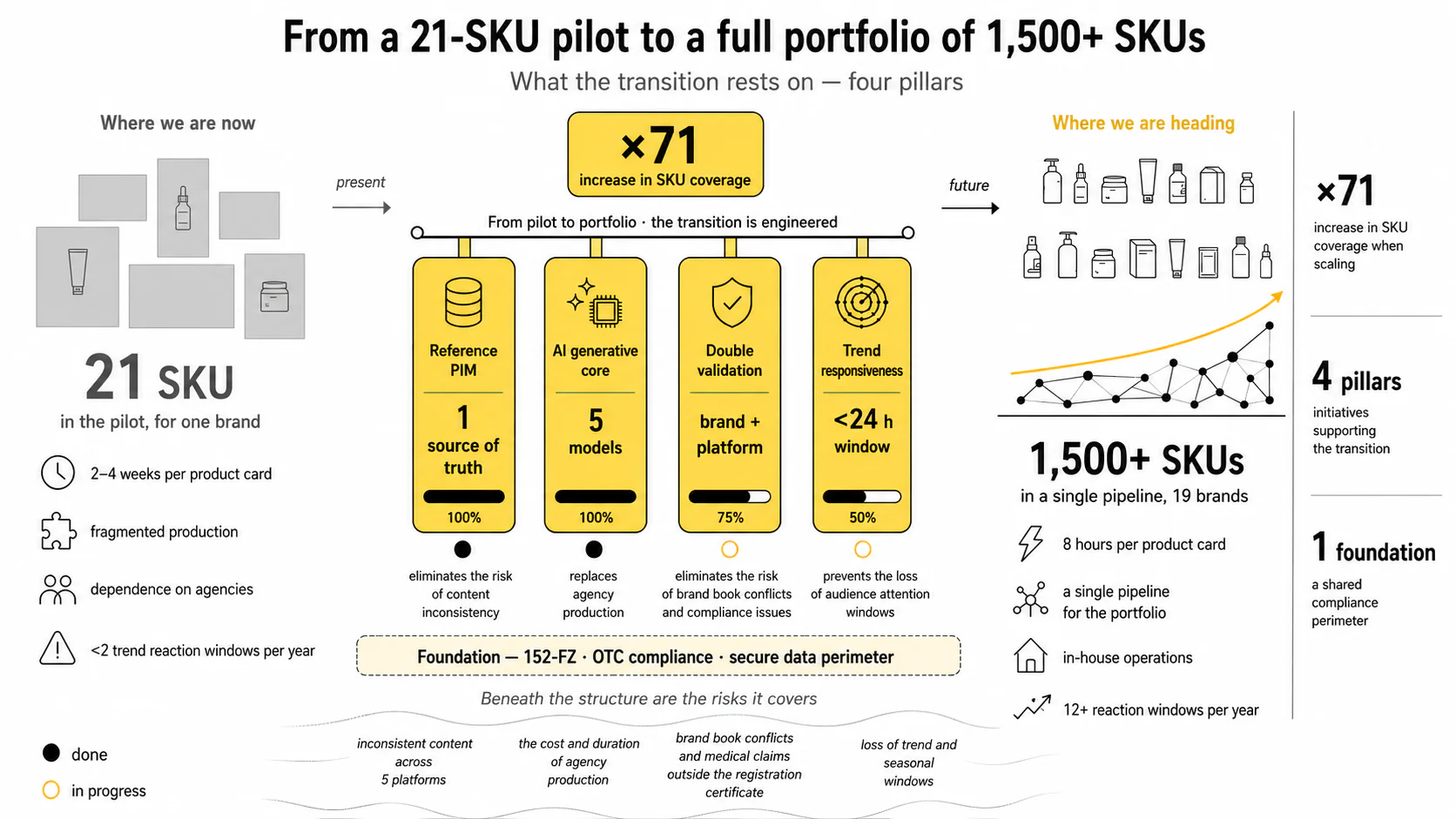
  • New SKU launch cycle: 2–4 weeks → 4–8 hours (significant acceleration)
  • Per-listing cost: substantial reduction vs. the agency model
  • Trend and news hook reaction window: weeks → <24 hours
  • From 2–3 news hooks per year to 12+ reaction windows
AI SEO Optimization for Product Listings — Scaling timeline
Scaling timeline
Strategic impact

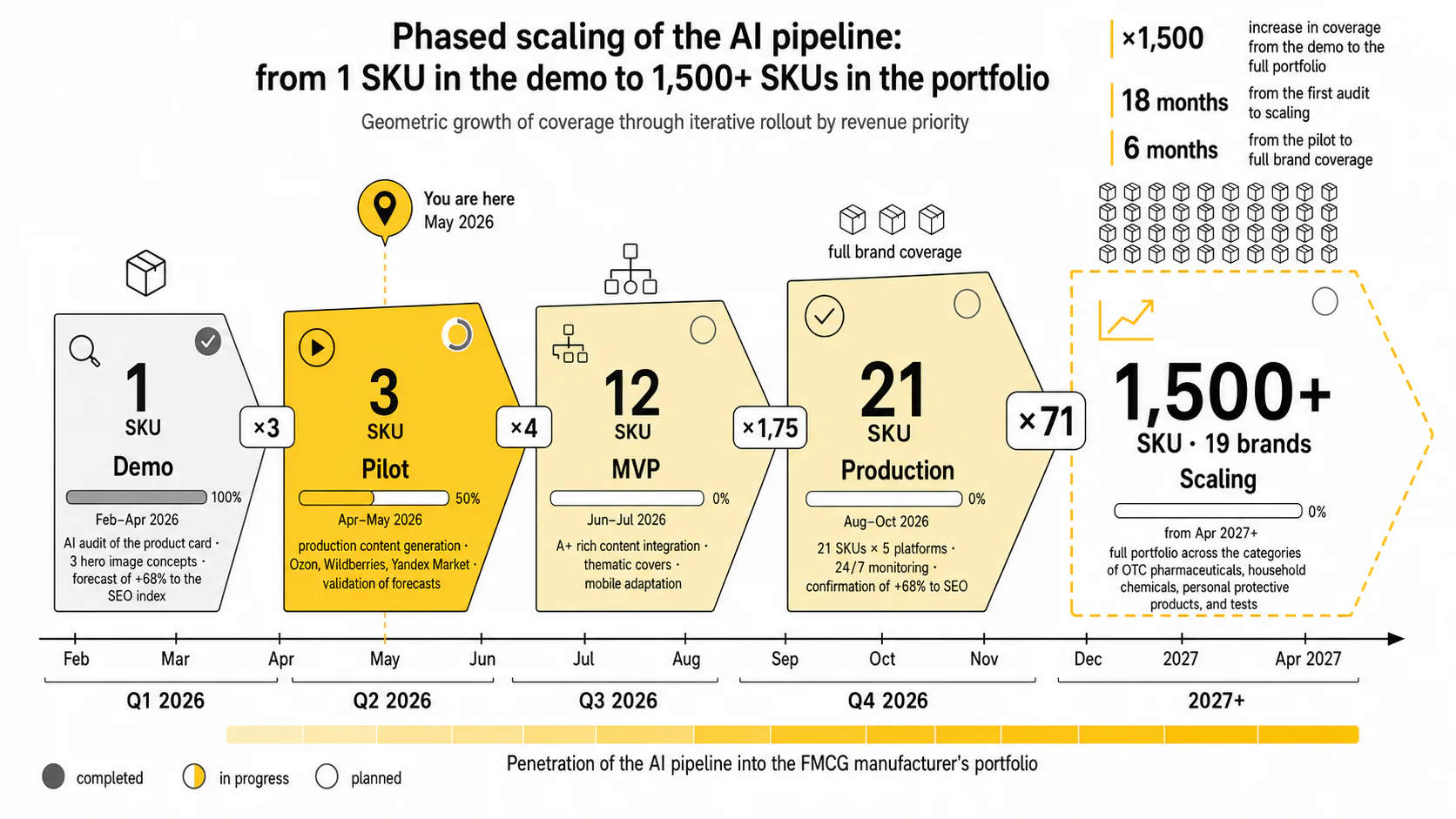
The pilot became a reference case for scaling across the manufacturer's full portfolio — 19 leading brands and over 1,500 SKUs across OTC pharma, household chemicals, personal protective products, and diagnostics.

Unifying e-commerce content under a single brand book standard across 5+ platforms removes dependency on agency resources and transforms listing work from one-off production into a managed process — the team plans at the portfolio level rather than individual SKU level.

AI SEO Optimization for Product Listings — From pilot to portfolio
From pilot to portfolio
AI SEO Optimization for Product Listings — Stakeholders
Stakeholders

The metrics and results presented reflect outcomes of a specific project and depend on its initial conditions. They are provided for informational purposes only, do not constitute a public offer, and do not guarantee similar results in other projects. Supporting materials are available on request.

Other cases

Facing a similar challenge?

Tell us about your process — we will suggest an audit, pilot, or full deployment.